Palaeo Jam
Palaeo Jam is a podcast exploring a range of issues in science and the community, using the multidisciplinary aspects of, and public fascination with, palaeontology. Palaeo Jam uses fossils, and other objects and research from palaeontology, to explore a range of scientific and social issues, and incorporate key discoveries into its content. That fancy description aside, it’s really an opportunity for host Michael Mills to chat with his palaeo pals and learn some cool things!
Each episode is restricted to a maximum of 30 minutes. Each episode has a panel of up to three guests, and is hosted by award-winning science communicator Michael Mills.
You can buy a Palaeo Jam mug, and eventually othersPalaeo Jam merch from the Dinosaur University shop at https://dinosaur-university.teemill.com/








Episodes

Dec 12, 2025
Dec 12, 2025
30 min
Adele Pentland (Curtin University) and Sally Hurst (Macquarie University), are both Superstars of STEM with extensive experience in public engagement and media communication. They are both palaeontologists, which we think gives them a bit of an advantage over some of the other sciences, since we’re the ones with dinosaurs!
In a wide ranging conversation, host Michael Mills chats with Adele and Sally about why effective communication matters for the public understanding of ancient life Along the way, they discuss several successful outreach strategies, science heroes, and offer practical advice for scientists and educators looking to communicate their research more engagingly.
This is the first in a series of episodes recorded during the 2025 CAVEPS Conference in vertebrate palaeontology at Flinders University in South Australia in November, 2025.
You can find Adele’s podcast, “Pals in Palaeo” through the following link… https://linktr.ee/palsinpalaeo
Be sure to follow the podcast on Instagram at https://www.instagram.com/palsinpalaeo/
You can also head to the Pals in Palaeo website at https://palsinpalaeo.com/
Check out Sally’s website at https://www.sallyhurst.com.au
And her Found a Fossil website at https://www.foundafossil.com/
Found a Fossil also has an Insta account at https://www.instagram.com/foundafossil
And a Tik Tok account at https://www.instagram.com/foundafossil
You can find Michael on Blue Sky at https://bsky.app/profile/heapsgood.bsky.social
To connect with Dinosaur University on Facebook, follow us at https://www.facebook.com/DinosaurUniversity
At Palaeo Jam, we have an Instagram account at https://www.instagram.com/palaeo_jam

Nov 21, 2025
Nov 21, 2025
30 min
What actually is a kangaroo? And how long have they been the giant red or grey hopping things so synonymous with Australia? In this episode of Palaeo Jam, host Michael Mills chats with Dr Isaac Kerr about the origin of kangaroos as “weird possums that lived in the trees a bit”, the significant gaps in the kangaroo origin fossil record, and how we make sense of what we’ve got. In a wide ranging conversation about kangaroo origins, they also discuss why of all the locomotion strategies that could have been adopted, Australia is the only place where large animals have taken to hopping.
You can follow Isaac on Blue Sky at https://bsky.app/profile/isaacarkerr.bsky.social
Isaac’s latest paper, “Limb osteology and functional morphology of the extinct kangaroo Dorcopsoides fossilis”, can be found at…
https://royalsocietypublishing.org/doi/10.1098/rsos.251591
It was in Episode 1 of Season 3 that Michael and Isaac first chatted about the prehistoric group of kangaroos, Protemnodons. Find the episode here…
https://palaeojam.podbean.com/e/the-tale-of-a-giant-prehistoric-kangaroo-or-three/
You can read the full 250 plus pages of Isaac’s remarkable paper on Protemnodon, here…
https://mapress.com/mt/article/view/megataxa.11.1.1
Here’s a link to the Flinders University palaeo team…
https://sites.flinders.edu.au/palaeontology/
You can find Michael on Blue Sky at https://bsky.app/profile/heapsgood.bsky.social
To connect with Dinosaur University on Facebook, follow us at https://www.facebook.com/DinosaurUniversity
At Palaeo Jam, we have an Instagram account at https://www.instagram.com/palaeo_jam

Oct 17, 2025
Oct 17, 2025
30 min
On Thursday October 9th, Dr Jim Gehling OA (Order of Australia) was awarded the Joseph Verco Medal by the Royal Society of South Australia for a remarkable life of research and public engagement in the field of palaeontology. Previous recipients have included Sir Douglas Mawson and Reg Sprigg.
Palaeo Jam host Michael Mills is a long time friend of Jim, with Jim having been a central part of the South Australian Museum's work in the early days of the birth of Michael’s alter ego, singing palaeontologist Professor Flint. Michael notes in this podcast that the work he does as The Prof, is only possible because of the work of people like Jim.
After attending the award ceremony, Michael and Jim decided to arrange a time to catch up and chat about Jim’s life and his research. This is just part of what was a delightful day of sharing memories with Michael, Jim, and wife Inara.
Jim has led Ediacaran research in Australia, and the world, for the last 40 years, collaborating with all significant international experts and co-authoring publications on the Ediacara Biota in Australia, Canada, USA, UK, China, Russia, and Namibia. He has also been intimately involved on the excavation and research of the early Cambrian Emu Bay Shale of Kangaroo Island. The Emu Bay Shale is the only Konservat-Lagerstätte in the Southern Hemisphere and is often mentioned side by side with the likes of the Burgess Shale in British Columbia.
Jim’s research record is extensive. You can find links to some of his research on google scholar at https://scholar.google.com.au/citations?user=kMfMg40AAAAJ&hl=en
Or on Research Gate at… https://www.researchgate.net/profile/James-Gehling
Last year, inspired by Jim’s research on the Ediacarans and early Cambrians, Michael's Professor Flint released an album of songs, for children titled “Creatures of the Slime”. You can find the album on all main platforms via the following link…
https://linktr.ee/ProfessorFlint
You can follow Michael on Bluesky at https://bsky.app/profile/heapsgood.bsky.social
And his HeapsGood Facebook page at
https://www.facebook.com/HeapsGoodProductions

Sep 26, 2025
Sep 26, 2025
30 min
Australia is land of reptiles, and in particular, a land of lizards. How and when did it become this? And why are there so many venomous snakes? In this episode of Palaeo Jam, host Michael Mills chats with Dr Mark Hutchinson about the evolutionary history of the lizards of Australia, why they become a life long passion, if he has a favourite lizard, (he does, and explains why), and the rewards of being a research supervisor.
Dr Mark Hutchinson is an Australian herpetologist and palaeontologist, long associated with the South Australian Museum, where he served as Curator of Herpetology before becoming an Honorary Researcher. His work has focused on the taxonomy, evolution, and fossil history of reptiles—especially lizards and snakes—across Australia’s arid and southern regions. He has described numerous new species, reconstructed ancient ecosystems from fossil remains, and explored how climate shifts shaped reptile diversity. In addition to his museum role, Dr Hutchinson has held academic posts with the University of Adelaide and Flinders University, and is recognised internationally for his contributions to understanding the deep history and conservation of Australia’s reptiles.
Dr Mark suggests that if you want to learn about Australian lizards, a great intro is “Australian Lizards- A Natural History” by Steve Wilson. And if it’s more on Aussie snakes you’re after, “Australian Snakes: A Natural History” by Dr Richard Shine. Check your local book and ebook retailer for availability.
Host Michael Mills can be found on Insta as The HeapsGood Guy at https://www.instagram.com/heapsgood/
On Bluesky at https://bsky.app/profile/heapsgood.bsky.social
For all things HeapsGood, including links to Michael alter ego, Professor Flint, head to…
https://linktr.ee/heapsgoodproductions

Sep 12, 2025
Sep 12, 2025
30 min
And then what?
It tuned in to this very episode of Palaeo Jam!
Dr Heather Robinson and Professor John Long are the authors of two important books, “Beyond the Books: Culture, value and why libraries matter.” and “The Secret History of Sharks: The Rise of the Ocean's Most Fearsome Predators”, respectively.
Heather and John are also work partners and life partners, and in this episode of Palaeo Jam we explore the essence of each of their very different books, while attempting to find common ground. Along the way we ask, why do libraries matter? Indeed, why do cultural institutions matter? And why do sharks matter? In researching each of the books, what was the most surprising thing you discovered about libraries and sharks? And why are both of these books an important read, right now? Because, yes. They are!
You can find both books on-line, and at all good bookstores.
John’s paleontological CV is vast! A look through profile on The Conversation at https://theconversation.com/profiles/john-long-98402 will give you a small insight into John’s remarkable body of work.
Heather also has an extensive profile on The Conversation, at https://theconversation.com/profiles/heather-l-robinson-155358
Heather and John have created Lifecyle Productions as an instrument to work on a multitude of projects. Their company website is… https://lifecycleproductions.com.au/, and contains information about what they’re working towards, and about the skills they each bring.
We first chatted with Heather and John in episode 3 of season 1 titled "A Marriage of Art and Science" in which amongst other things, we explored the importance of their art/science collaborations, and the things they each bring to their working partnership, and delved into some of the delightful experiences that their working on things together as a married couple has brought them.
Michael and John have collaborated creatively through the creation of the Professor Flint song about the WA fossil emblem, the Gogo Fish. With lyrics by John, and music by Michael, the song features on the Professor Flint album, “Dinosaurs Amongst Us!”… The Gogo Fish song on Spotify

Aug 22, 2025
Aug 22, 2025
30 min
Regional museums in Australia and elsewhere are the custodians of a remarkable collection of stories. What are some of those stories, and why do they matter? Why, indeed, do regional museums matter? And what kinds of science, including palaeontology, takes place in the regions?
Palaeo Jam host Michael Mills recently travelled to Geraldton in Western Australia for a series of National Science Week events. The events were held at Blue Heelers Square and included a family show by emerging, all female dinosaur loving supergroup The Ammonites, a quiz night, and the recording of the first episode of Season 4 of the Palaeo Jam podcast. This is that recording, and we can’t think of a better way to begin our fourth season, than to chat about the importance of science and science engagement in the regions.
In this episode, Michael is joined by Dr Kailah Thorn, Project Coordinator (Biodiversity) Western Australian Museum, Lucy Stokes, Palaeontology PhD Candidate, Curtin University, and Sarah Walker, Learning and Engagement Officer, Western Australian Museum- Geraldton to discuss all things regional and science.
For more information on the Western Australian Museum, head to their website at…
https://visit.museum.wa.gov.au/
For more information on the awesome venue, Blue Heelers Square where we recorded this episode, head to…
https://www.blueheelerssquare.com.au/
For more information on The Ammonites, who we’ll hear from in a future episode, head to…
https://linktr.ee/theammonites
Sep 14, 2024
Sep 14, 2024
30 min
Just over 12 months ago, as part of National Science Week, we spoke with Eleanor Beidatsch, in an episode titled, “A Journey into accessibility: Digging for fossils from a wheelchair.” Since that episode, Eleanor has graduated from the University of New England with First Class Honours, been awarded the $130,000 #ElevateSTEM scholarship for postgraduate research from the Australian Academy of Technological Sciences and Engineering, and has started her Masters!
As we noted in the notes to last year’s episode, “as a nine year old, Eleanor dreamed of being a palaeontologist, but always presumed her advanced physical disability, and use of a wheelchair would make “digging about in the dirt for fossils” impossible.”
In this episode of Palaeo Jam host Michael Mills chats with Eleanor about another remarkable 12 months, and about what lies ahead as she continues her brilliant journey in the world of palaeontology, and follows her fascination with prehistoric velvet worms!
Check out this story from the ABC about Eleanor’s graduation…
https://www.abc.net.au/news/2024-05-26/eleanor-beidatsch-graduates-first-class-honours-geoscience/103839886
Here’s a link to last year’s episode with Eleanor…
https://palaeojam.podbean.com/e/a-journey-into-accessibility-digging-for-fossils-from-a-wheelchair/
Check out this video from Eleanor’s YouTube channel of her remarkable adventure in 2016, to a paleontological dig in the opal rich desert town of Lightning Ridge, New South Wales…
https://www.youtube.com/watch?v=aTGxIR_yaNo
Here’s a story about Eleanor’s journey on the University of New England’s website…
https://www.une.edu.au/connect/news/2022/09/unearthing-discrimination-in-science
Along with studying palaeontology, Eleanor is a disability rights journalist, and writes for the ABC…
https://www.abc.net.au/news/eleanor-beidatsch/101651018
Here’s a link to the Elevate STEM website…
https://www.atse.org.au/what-we-do/pathways-into-through-stem/elevate/
You can find Eleanor on Instagram at…
https://www.instagram.com/eleanor.beidatsch/
And on Twitter at…
https://twitter.com/EBeidatsch
Here’s a link to Eleanor’s blog Accessible 4 Me…
https://accessible4me.wordpress.com/
For more information on the research being undertaken by the team at University of New England’s Palaeoscience Research Centre, head to
https://www.une.edu.au/research/research-centres-institutes/palaeoscience-research-centre
You can find Michael at @heapsgood https://twitter.com/Heapsgood
To connect with Dinosaur University on Facebook, follow us at https://www.facebook.com/DinosaurUniversity
At Palaeo Jam, we now have an Instagram account at https://www.instagram.com/palaeo_jam
Aug 16, 2024
Aug 16, 2024
30 min
So, you want to become a fossil? Good luck with that! There’s a whole sequence of things that need to take place in order for that to happen, and in this episode of Palaeo Jam, we explore those steps, and how unlikely it is that you will be able to complete all of them.
Recorded underground in Blanch Cave, in the Naracoorte Caves, South Australia, this episode sees host Michael Mills in conversation with PhD candidate Nerita Turner. Nerita’s work focuses on the modes of accumulation of large animal remains in caves, and we explore the unlikelihood becoming a fossil through the lens of her work. In order to become a fossil in a cave, you need to get into a cave in the first place. How does this impact on the size and kinds of animals that might then become fossils within a cave?
During the conversation Nerita describes the fossil record as “Infamously incomplete”. So, how incomplete is it? Consider the following… There are 1400 dinosaur species of dinosaurs that have been discovered and named across the entire Mesozoic, while right now there are around 11 000 species of living dinosaurs, in birds. How many dinosaur species lived across the entire 186 million year period of the Mesozoic? We will never know.
Of course, what we do know, is truly remarkable, and a testament to the work of so many. Palaeontology is able to provide us with some remarkable insights into past lives. to uncover past lives. It is important, however, to understand, that we get to see will only ever be a tiny glimpse of the extraordinary natural history, of this most astonishing planet.
Nerita Turner is a PhD Candidate at the University of Adelaide. Her research focuses on the modes of accumulation of large animal remains in caves, with a particular focus on fossil sites within the Naracoorte Caves region.
You can find Nerita on Twitter at https://twitter.com/nerita_turner
Check out the following article, by Nerita and Dr Elizabeth Reed…
“Using historical research to constrain the provenance and age of the first recorded collection of extinct Pleistocene large mammal fossils from the Naracoorte Caves, South Australia.”
https://www.tandfonline.com/eprint/M7JARRBWBXBWDCFDGIIY/full?target=10.1080/03721426.2023.2188442
Michael occasionally pops in to the strange place that is Twitter at @heapsgood https://twitter.com/Heapsgood
To connect with Dinosaur University on Facebook, follow us at https://www.facebook.com/DinosaurUniversity
At Palaeo Jam, we now have an Instagram account at https://www.instagram.com/palaeo_jam
About Palaeo Jam
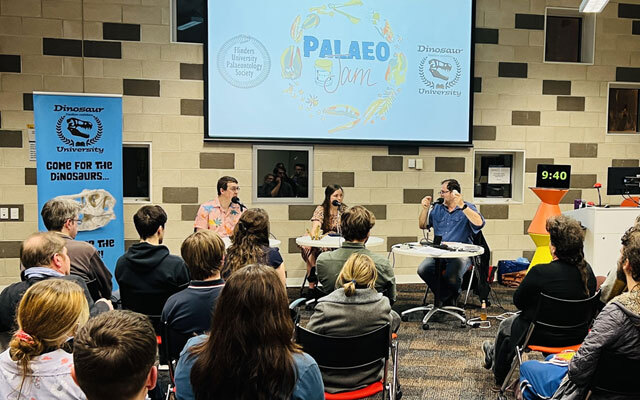
Palaeo Jam is a podcast exploring a range of issues in science and the community, using the multidisciplinary aspects of, and public fascination with, palaeontology. It is an Australian-based palaeo podcast, which launched at a publicly accessible live event at Flinders University, where the first two episodes were recorded in front of an audience.
The format for Palaeo Jam is as follows
- Palaeo Jam uses fossils and other objects from palaeontology to explore a range of scientific and social issues, and incorporate key research and discoveries into its content. Each guest brings an object.
- Each episode has a theme.
- Each episode is strictly 30 minutes in length. There is always a timer present, and visible to the audience in live records.
- Each episode has a panel of up to four, including Michael Mills as the host. We aim to give voice to researchers who don’t often get the opportunity to participate in such forums.
- Palaeo Jam is discussion, curiosity, and exploration, rather than being a collection of presentations. Through pondering connections between items, we hope to uncover insights and delve into unusual and interesting corners of palaeontology.
- Show notes for people to dive deeper are uploaded to this website, with the work of each panelist being highlighted.