Palaeo Jam
Palaeo Jam is a podcast exploring a range of issues in science and the community, using the multidisciplinary aspects of, and public fascination with, palaeontology. Palaeo Jam uses fossils, and other objects from palaeontology, to explore a range of scientific and social issues, and incorporate key research and discoveries into its content. that fancy description aside, it’s really an opportunity for host Michael Mills to chat with palaeontologists and learn some cool things!. Each episode is restricted to a strict, 30-minute timeframe. Each episode has a panel of up to three guests, and is hosted by award-winning science communicator Michael Mills. You can but a Palaeo Jam mug, and eventually others Palaeo Jam merch from the Dinosaur University shop!
Listen on:








Episodes
Sunday Nov 27, 2022
Sunday Nov 27, 2022
On the 3rd August, 1969, some 53 years ago, a young biologist, Rod Wells, along with his friend, caver Grant Gartrell crawled through a narrow opening at Naracoorte's Victoria cave, and made a remarkable discovery. It was to be one of the most remarkable finds of megafauna fossils found anywhere in the world, and played a significant part in the Australian megafauna site being elevated to the World Heritage list in 1994
In this special one on one edition of Palaeo Jam, host Michael Mills chats with Prof Rod Wells in an episode recorded with both Rod and Michael sitting in the very spot Rod had sat 53 years ago, on that amazing Spring day.
Rod’s discoveries played a significant role in the development of Vertebrate Palaeontology at Flinders University, and there are a generation of students now following in his footsteps as a result of his passion and his work. His research and insights into Australia's fossil heritage across many years has helped Australians better know the stories of their past, and in so doing, has helped Australians to better know who they are.
And while, of course, this podcast is an audio thing, so you don’t get to see Rod and Michael chatting, the very fact that it was recorded in that place where Rod sat all those years ago, made for a very special conversation.
Friday Nov 11, 2022
Friday Nov 11, 2022
When we think of Australia and its wildlife, the first thing that comes to mind is the iconic, often-hopping, marsupials! (Ok… and all the things might kill and maim you!) In exploring Australia’s recent prehistoric past, it’s also often the marsupials that we get to hear of. Giant wombats, rather large, short-faced kangaroos, and leopard-sized, scissor-toothed, tree-climbing pouched predators!
What we don’t often think of, is Australia as a land of vultures and flamingoes! And yet, the evidence now tells us that these birds also made Australia home. We’ve known about flamingoes living in the Land Down Under for a while, but its only very recently that fossils have come to light to tell us that vultures in Australia were also a thing.
In this episode of Palaeo Jam, host Michael Mills chats with Dr Ellen Mather, Adjunct Associate lecturer at Flinders University, and Tim Niederer, PhD student, also at Flinders University, about these lesser known Australians, what we know of them, and why they may have gone extinct.
A great article examining Ellen’s recent work on the discovery of vultures in Australia can be found here…
https://theconversation.com/it-was-long-thought-these-fossils-came-from-an-eagle-turns-out-they-belong-to-the-only-known-vulture-species-from-australia-187017
Ellen was also co-author for an article on a prehistoric species of eagle… https://theconversation.com/meet-the-prehistoric-eagle-that-ruled-australian-forests-25-million-years-ago-168249
You can find Ellen on Twitter at https://twitter.com/Ellenaetus
Here’s a link to a 1963 chapter on fossilised flamingo bones from Australia…
https://sora.unm.edu/sites/default/files/journals/condor/v065n04/p0289-p0299.pdf
And here’s a short mention in National Geographic… https://www.australiangeographic.com.au/topics/wildlife/2017/02/australia-was-once-full-of-flamingos/
We all very much look forward to the additional insights that Tim’s research will bring to our understanding of the place of these fascinating birds in Australia.
You can find Tim on Twitter at https://twitter.com/Gaylaeontology
Each episode of Palaeo Jam is recorded with a strict 30 minute time-limit and is unedited. What you hear is how it went! As part of each episode, the host and each guest bring along an object to open the discussion on the day’s theme. Michael’s item was part of a skull of Thylacoleo. Tune in to find out what Ellen and Tim brought along, and what it all means for what prehistoric Australia looked like.
Friday Oct 21, 2022
Friday Oct 21, 2022
Or does it? In the latest episode of Palaeo Jam, host Michael Mills talks to Dr Diana Fusco and Nathan Phillips of Flinders University about what it’s actually like to head into the field, and dig up fossils. All three have had multiple opportunities to go out to dig sites and do so, and in this podcast, each of them give some great insights into life in the field, and what it is really like!
In so doing, we delve into some into the challenges of working remotely! What happens, for example, when you leave behind a critical part of the thunderbox on a remote field trip? And what even is the thunderbox? Tune in to find out!
Each episode of Palaeo Jam is recorded with a strict 30 minute timer-limit and is unedited. What you hear is how it went! As part of each episode, the host and each guest bring along an object to open the discussion on the day’s theme. Michael’s item was a half a billion year old Trilobite fossil he dug up in Emu Bay, South Australia. Tune in to find out what Diana and Nathan brought along.
Dr Diana Fusco is a palaeoecologist, who combines palaeontology and ecology, to explore interactions between organisms and their environments across geological timescales. Her PhD at Flinders University focused on how Australia’s fauna countered its changing environment in the past, and how this information can be applied as a tool for current and future conservation. As part of her involvement with the Flinders University Palaeontology Society, Diana has been actively involved on the organisational side of field trips.
You can find her on Twitter at https://twitter.com/HvyMetalPalaeo
And if you want to see what an actual thunderbox looks like, check out her Twitter post here… https://twitter.com/HvyMetalPalaeo/status/1578242452770631680
Nathan Phillips has been actively involved with the Flinders Uni Palaeo lab since primary school and the Flinders University Palaeontology Society since high school. Along the way he did a bachelor of science with a major in vertebrate palaeontology, has run the moulding and casting for the Flinders palaeo Lab, and was more recently a tour guide for Australian Age of Dinosaurs in Winton Qld.
Sunday Oct 02, 2022
Sunday Oct 02, 2022
Art and Science are often thought to be polar opposites. The truth, though, as Palaeo Jam podcast host Michael Mills can attest having successfully worked in the Art/Science space for more than 25 years, is that the two can make for a remarkable and inspiring marriage.
Speaking of marriages, Michael’s guests in this episode, are Dr Heather Robinson and Professor John Long. In this episode we explore the importance of their art/science collaborations, and the things they each bring to their working partnership. We also delve into some of the delightful experiences that their working on things together as a married couple has brought them. Along the way, we gain an insight into the fascinating research they have each conducted. For John, fossil fish have been a big part of his research. For Heather, exploring the non-financial value of cultural institutions and their collections was the central focus of her PhD.
John’s paleontological CV is vast! A look through profile on The Conversation at https://theconversation.com/profiles/john-long-98402 will give you a small insight into John’s remarkable body of work.You can find John on Twitter at… https://twitter.com/LongJohnfossil
Heather also has an extensive profile on The Conversation, at https://theconversation.com/profiles/heather-l-robinson-155358
Heather and John have created Lifecyle Productions as an instrument to work on a multitude of projects. Their company website is… https://lifecycleproductions.com.au/, and contains information about what they’re working towards, and about the skills they each bring. The website notes…
“Based in Australia with an international perspective, Lifecycle Productions live for a good story. Our unique combination of creative insight, professional acumen and research expertise produces experiences accessible to broad or specialist audiences.”
Michael and John have collaborated creatively through the creation of the Professor Flint song about the WA fossil emblem, the Gogo Fish. With lyrics by John, and music by Michael, the song features on the Professor Flint album, “Dinosaurs Amongst Us!”… The Gogo Fish song on Spotify
While an unplugged version appears on the Prof Flint album, “Palaeo Jam”, from which this podcast got its name… Palaeo Jam album on Bandcamp
Friday Sep 02, 2022
Friday Sep 02, 2022
Matrescence has been defined as “the physical, emotional, hormonal and social transition to becoming a mother.”
In a recent blog titled “Palaeo-matrescence”, Dr Alice Clement noted the following…
“I wanted to seek advice from colleagues who had navigated the same journey as me, but it was difficult to find people in the same boat. I could see plenty of “parents in palaeo”, but looking for mothers (in the traditional, biological sense) was a harder task. Where are they all?”
In this episode of Palaeo Jam, host Michael Mills is joined by Alice, and Dr Vera Weisbecker, to discuss the impact and challenges having children has had on the careers of women in palaeontology, and whether or not things have changed over the years.
To Alice’s full blog, head to… https://draliceclement.com/2022/07/06/palaeo-matrescence/
For more of Alice’s blog posts, check out https://draliceclement.com, and follow Alice on Twitter at https://twitter.com/DrAliceClement.
Dr Vera Weisbecker is an evolutionary developmental morphologist, which is a fancy way of saying she likes to study the diversity of Australian land vertebrates in all their glory. You can follow Vera on Twitter at https://twitter.com/WeisbeckerLab
Vera has just finished developing a game to transmit her team’s love for Australian present and past biodiversity and the evolutionary process behind it. It’s called “Go Extinct! Megafauna edition”. It can be downloaded for free through the Centre of Excellence for Australian Biodiversity and Heritage… https://epicaustralia.org.au/resource/goextinctmegafauna/
Friday Aug 26, 2022
Friday Aug 26, 2022
Palaeontology is often seen as one of the cool sciences, if not the coolest, because, of course, it’s the one with dinosaurs!
Is there more to it, though?
Don’t get us wrong… dinosaurs are awesome!
Does palaeontology have any practical use to the community? Is there any real value beyond thinking it’s cool, that palaeontology brings to the table?
In this episode of Palaeo Jam, host Michael Mills is joined by Dr Aaron Camens, (lecturer in palaeontology at Flinders University), and Pheobe McInerney, (PhD Candidate at Flinders University) to discuss all the things, and what they think makes palaeontology such a valuable science.
In pondering this very issue, Aaron recently said…
“The fossil record records diversity but it is much more than that. It contains abundant data about how past ecosystems have functioned, the kinds of habitats extinct organisms used to live in and their environmental tolerances. Without the fossil record we wouldn’t understand nearly as much as we do about how today’s ecosystems will respond to change going into the future…”
You can follow Aaron on Twitter at https://twitter.com/DiprotoRon, and check out his Flinders University profile at https://sites.flinders.edu.au/palaeontology/home/people/academics/aaron-camens/
Amongst his extensive research work, Aaron co-authored a paper that gave us a more complete picture of the largest marsupial predator known, Thylacoleo carnifex. https://journals.plos.org/plosone/article?id=10.1371/journal.pone.0208020
Phoebe is on Twitter at https://twitter.com/Phoebyornis Check out her recent article in The Conversation about disease in giant prehistoric birds, and how we know about it.
https://theconversation.com/fossil-find-reveals-giant-prehistoric-thunder-birds-were-riddled-with-bone-disease-173745
About Palaeo Jam
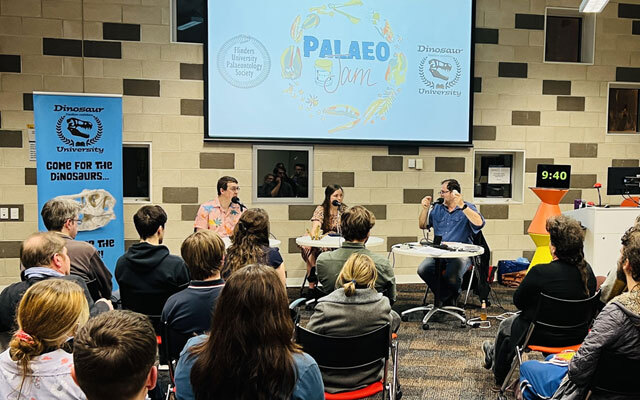
Palaeo Jam is a podcast exploring a range of issues in science and the community, using the multidisciplinary aspects of, and public fascination with, palaeontology. It is an Australian-based palaeo podcast, which launched at a publicly accessible live event at Flinders University, where the first two episodes were recorded in front of an audience.
The format for Palaeo Jam is as follows
- Palaeo Jam uses fossils and other objects from palaeontology to explore a range of scientific and social issues, and incorporate key research and discoveries into its content. Each guest brings an object.
- Each episode has a theme.
- Each episode is strictly 30 minutes in length. There is always a timer present, and visible to the audience in live records.
- Each episode has a panel of up to four, including Michael Mills as the host. We aim to give voice to researchers who don’t often get the opportunity to participate in such forums.
- Palaeo Jam is discussion, curiosity, and exploration, rather than being a collection of presentations. Through pondering connections between items, we hope to uncover insights and delve into unusual and interesting corners of palaeontology.
- Show notes for people to dive deeper are uploaded to this website, with the work of each panelist being highlighted.